Showing posts with label Christmas. Show all posts

Thursday, December 23, 2010

A Christmas Meditation

This is a brief excerpt from Augustine's Confessions as he ponders the meaning of Jeremiah 23:24 which says, "Can a man hide himself in secret places so that I cannot see him? declares the Lord. Do I not fill heaven and earth? declares the Lord." (my emphasis)


[1.3] (all the "you"s are referring to God) "Do heaven and earth, then, contain the whole of you, since you fill them? Or, when once you have filled them, is some part of you left over because they are too small to hold you? If this is so, when you have filled heaven and earth, does that part of you which remains flow over to some other place? Or is it that you have no need to be contained by anything, because you contain all things in yourself and fill them by reason of the very fact that you contain them? For the things which you fill by containing them do not sustain and support you as a water-vessel supports the liquid which fills it. Even if they were broken to pieces, you would not flow out of them and away. And when you pour yourself out over us, you were not drawn down to us but draw us up to yourself; you are not scattered away, but you gather us together.

"You fill all things, but do you fill them with your whole self? Or is it that the whole of creation is too small to hold you and therefore holds only a part of you? And is this same part of you present in all things at once, or do different things contain different parts of you, greater or smaller according to their size? Does this mean that one part of you is greater and another smaller? Or are you present entirely everywhere at once, and no single thing contains the whole of you?"

There's no doubt that trying to wrap one's mind around the immensity of God is an exercise in futility!

... and this mind-bogglingly BIG God became a human baby...

Thursday, December 16, 2010

Chritsmas, Trees, and the Beginning and End of Time

In past Christmas seasons I've blogged about all sorts of different aspects of our Christmas traditions. Usually I just pick a pet peeve and sort of "have at it." In typical post-modern fashion I've picked apart perceived portions of the narrative that I think are inaccurate; things like the non-existent inn, the time frame of the magi, the date of Christmas itself, and the whole "x"mas thing.

But I was reminded, as I was picking out our Christmas tree for this year, that I haven't blogged about the origins of the Christmas tree yet. So, maybe you'll know some of this, maybe you won't. Either way, here it goes:

Many people have tried to claim that the Christmas Tree has more roots in paganism than in Christianity. Certainly a case can be made; there are all sorts of different pagan religions that have used evergreens in their religious symbolisms. Naturally, these are also often in connection with the winter solstice. This just makes sense, 'cause what other symbol would you want to use to remind you of life and hope in the middle of winter than the only plant that is still alive and green!

There are a number of good examples of this: winter solstice in ancient Egypt involved decorations of green date palms. In Rome it was evergreen boughs for the celebration of Saturnus, the god of agriculture. In old Britain the druids put evergreen boughs over their doors to ward away evil spirits. And other northern European religions had traditions like the yule log.

None of these are anything quite like the Christmas tree, but you can see how people would extrapolate these pagan traditions and use them to explain away the origins of the Christmas tree. After all, there's nothing more that some people like than to "prove" that Christianity is really just a complex amalgamation of older pagan religions.

Anyway, regardless of it's questionable pagan origins, the vast majority of people agree that the Christmas Tree itself originated in Germany. There are two very interesting tales that root the Christmas Tree's origins to Christianity: Boniface & Luther.

St. Boniface was as missionary to the Germanic/Frankish people in the 700s AD. The story goes that one day Boniface ran into a large group of people worshiping a pagan god under an oak tree. As he had been ministering to these people for quite some time now, out of anger and frustration he ran over to the oak and started to chop it down. Of course, the people were shocked and warned him of the "heresy" he was committing, but Boniface (in very Elijah-like style) simply said that if the god was real he could strike him dead for this blasphemy... and continued to chop down the tree.

Well, the tree fell and Boniface was still alive, so the people converted to Christianity. It was then noted that in the place where the oak had once stood a fir tree grew in its place. This was then taken as a symbol of the supremacy of Christianity and Boniface supposedly then used the triangular shape of the fir tree to teach the people about the trinity.

Well, that doesn't quite take us right up to the Christmas Tree, but it shows us an early origin of the evergreen tree as a symbol of Christianity over and above paganism.

The other story takes us right into the period of the Reformation. This story goes that, after being ousted from the Catholic Church, Martin Luther had a lot of time on his hands and spent a significant amount of that time roaming the woods of Germany, thinking about his beliefs and the beliefs of the Church.

Well, one evening on Christmas Eve, Marty was walking through the woods and was struck by the astounding beauty of God's creation. He was blown away by the beauty of a stand of fir trees in the snow, lit by moonlight and stars. Trying to explain this experience to his family, but unable to put it into words, he went out and cut down a tree, brought it into his house, and then decorated it with candles. Since it was Christmas Eve Luther then taught his children about how Jesus, whose birth they were about to celebrate, was the light of the world. From then on, this tradition spread among Protestants as an alternative to the Nativity Scenes that the Catholics had become so enraptured with (Francis of Assisi started that one!).

So, whether these stories are to be taken at face value, are purely fictional, or are legendary in the sense that they have a seed of historical fact, I leave up to you... but such are the Christian origins of the Christmas Tree.

The only other thing that I'll mention is this: if anybody has the right to claim trees as a religious symbol it is Christians (and perhaps Jews). After all, the Bible uses trees as its "bookends":

In the beginning we see: Genesis 2:9 (ESV) 9 And out of the ground the Lord God made to spring up every tree that is pleasant to the sight and good for food. The tree of life was in the midst of the garden, and the tree of the knowledge of good and evil.

And in the end we see: Revelation 22:1-3 (ESV) 1 Then the angel showed me the river of the water of life, bright as crystal, flowing from the throne of God and of the Lamb 2 through the middle of the street of the city; also, on either side of the river, the tree of life with its twelve kinds of fruit, yielding its fruit each month. The leaves of the tree were for the healing of the nations. 3 No longer will there be anything accursed, but the throne of God and of the Lamb will be in it, and his servants will worship him.

As I did a quick search I found literally dozens upon dozens of different passages that use trees as symbols for our faith. This post is already too long as it is, so I'll just leave you with these:

Psalms 92:12 (ESV) 12 The righteous flourish like the palm tree and grow like a cedar in Lebanon.

Proverbs 11:30 (ESV) 30 The fruit of the righteous is a tree of life, and whoever captures souls is wise.

Proverbs 13:12 (ESV) 12 Hope deferred makes the heart sick, but a desire fulfilled is a tree of life.

Proverbs 15:4 (ESV) 4 A gentle tongue is a tree of life, but perverseness in it breaks the spirit.

Jeremiah 17:7-8 (ESV) 7 "Blessed is the man who trusts in the Lord, whose trust is the Lord. 8 He is like a tree planted by water, that sends out its roots by the stream, and does not fear when heat comes, for its leaves remain green, and is not anxious in the year of drought, for it does not cease to bear fruit."

Merry Christmas!

Wednesday, December 15, 2010

Yesterday, and the Day Before

So, as I hinted at yesterday, this last Monday we took a trip into the forest to find, cut down, and bring home our Christmas tree. It's become a bit of a Christmas tradition in our family.
[Some of these pictures were just taken with my phone, so please forgive the lack of quality]

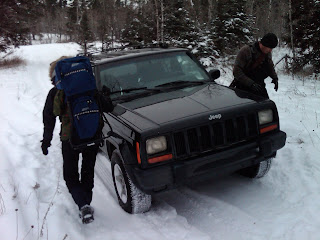
There was a fair bit of snow, so it was a lot of fun driving in.

It was a beautiful day. The temperature was about -10*C and not much for wind; a great day for a walk in the woods.

Unfortunately, Juanita caught the flu the night before so she couldn't come. Fortunately, Auntie Jess was willing to carry Luke around so he could still come on his first tree run.
We found our tree...
... strapped it on the Jeep...
... set it up at home...
... and then, yesterday, we decorated it.

It was a great day to spend in God's amazing creation with good friends and family!

And yes, this is a picture of a Jeep pulling a Ford up a hill! ;)

Tuesday, December 14, 2010

Wednesday, December 1, 2010

All is Calm?

"Silent night, holy night, all is calm..." Really? Calm? Have you ever seen a woman in labour? And I can't help but think that adding a bunch of stinky shepherds to the mix is going to help anything. "How silently, how silently the wondrous gift is giv'n..." Wondrous, yes. Silent, not likely!

"It came upon the midnight clear..." Well, I suppose it could have; it just doesn't say. All Matthew has to say is "Now after Jesus was born in Bethlehem..." (Mt. 2:1) and Luke simply states that "while they were there, the time came for her to give birth" (Lk. 2:6). Yes, the angels appeared to the shepherds at night (Lk. 2:8) but that's the closest time-frame we've got... I guess, in all fairness, the song is talking mostly about the shepherds and the angels... but then what's the point of the song? If it's not about Jesus, why bother singing it?

It doesn't take much to find some Carols that have inaccuracies, poor theology, or just silly statements. So should we scrap them?

Just this morning I ran across this quote which attempts to answer that question:

Should we get rid of Christmas Carols?
“Only with great care. For thousands, carols will be their only link with a church. At the same time, sentimentality is perhaps the single most dangerous feature of our Church and culture—and the sentimental air is never thicker than at Christmas. The Incarnation is messy, dirty, and resonates with the crucifixion. We need a new wave of carol writing that can gradually swill out the nonsense and catch the piercing, joy-through-pain refrains of the New Testament.” - Jeremy Begbie, professor of theology, Duke Divinity School

What do you make of that?
What carols are worth keeping?
Which carols are worth ditching?
Do you know of any new Christmas/Advent songs that are worth singing?

Tuesday, December 22, 2009

Merry Christmas

I hope that all of you have a wonderful time this year celebrating the amazing incarnation of God!

I hope that the angels' blessing in Luke 2:14 rings true in your life.

But, of course, I can't just leave it at that! Here's a fun little video that we'll be using during our Christmas Eve service:


This is a fun way to bring a bit more of a realistic, Biblical focus to our sometimes overly traditional celebrations.

If you want to look into this a bit more I'll point you back to a post that I did back in '07 (here) and to a recent post that Ben Witherington III did on his blog (here). If you have the time, his post is definitely worth the read. You'll also notice that he backs up my own theory that Jesus was simply born in a house and not a cave (certainly not a stable!).

The Bible says nothing about stables or caves. It does however mention a house (Mt. 2:11) and a guest-room/upper-room (Lk. 2:7 - see the NEB or the TNIV). Plus, archeological records from the 1st century show that many houses had mangers in their houses in the entryways.

Jesus was born in a house.

Anyway, rather than continuing the deconstruction of Christmas traditions I will echo the sentiments expressed in that fun little video: however you celebrate Christmas, whatever it looks like, don't let it go by without taking some time to meditate on the enormity of God becoming fully human.

Merry Christmas.

Tuesday, December 18, 2007

'Tis the Season

This last Sunday I said "ass" in church. Hehehehehe!


Well, I suppose I should say that I sang "ass" in church. Yes, it's that time of year when we all get to sing "What Child is this?" including the line "Why lies He in such mean estate, where ox and ass are feeding?" I remember as a kid being consumed with fits of laughter when we sang this song. Yeah, that's right, I haven't always been this mature (please note the sarcasm).

Don't you love this "stained glass ass" (come on, it rhymes, I had to say it) that has been immortalized even though he isn't even in the bible?

When you take a good look at Christmas Carols you just might notice that many of them are a great source of inaccurate information, bad theology and simply ridiculous statements. They definitely help reinforce some of the traditions that I have attempted to debunk in the last few posts.


Anyway, I do enjoy some carols. My personal favourite is "O Come, O Come, Emmanuel". It's theologically sound and it's in a minor key... what's not to like?

The "carols" that I really can't handle are the secular ones. Any songs that have Reindeer, Santa, elves, or the like just make me want to scream!

What is your favourite carol and why?
Which carol just drives you nuts and you're going to scream if you have to sing it one more time?
What silly statements, inaccuracies, or theological errors do you see in carols?

Tuesday, December 11, 2007

Making Christ in our Image

OK. Take a look at each of these pictures (Click on them for larger, clearer images).

What do you think?

Is one of them any more acurate or innacurate than the others?

What similarities are there?

Is it OK that Africans or Asians would think of Jesus as being African or Asian?

... or Caucasians as Caucasian?

Tuesday, December 4, 2007

What Have We Done to Christmas?

Every Christmas I hear a lot of talk (and do my share of talking) about how Christmas isn't what it should be; the business and bustle, the craziness of commercialism, the madness and mayhem of materialism, the glorification of gifts, etc...


That is all true, we really have messed up what celebrating Christmas should be and the "spirit" of Christmas. But we've also messed up the Biblical story. Here's what I mean... and I know that most of this is small picky stuff, but it all adds up to give us an inaccurate picture of Christ's birth:


There was no donkey. We always see pictures or paintings, or movies, or plays with Mary riding a donkey. I've even seen a play where the donkey was the main character. There was no donkey.


Well, I suppose there may have been a donkey but it is just as likely that it could have been a horse or a camel. Or maybe Mary walked or rode on the back of a cart. The fact is that we just don't know. The bible says absolutely nothing about how Mary and Joseph traveled to Bethlehem.


There was no inn. There was no inn and no inn-keeper. I've also seen a number of plays where the inn-keeper was a very main character. Guess what... He didn't exist.


This one needs a little explaining. First of all, there are no historical records indicating that Bethlehem had any sort of inn at this time period. Secondly, Bethlehem wasn't a big enough centre to have an inn, especially due to the fact that it was so close to Jerusalem.


But the the big reason is that there has been a gross translation error in many English Bibles every since the KJV translated the Greek word κατάλυμα (kataluma) as "inn". Kατάλυμα really means "guest room" (the TNIV, NLT, and other newer translations have corrected this error). This makes way more sense due to the fact that this was Joseph's home town. Joseph would have had family to stay with in Bethlehem. The guest room was full, so when Jesus was born they lay him in the manger that was in the entrance of every first century Jewish home. That's why the bible states this all so nonchalantly.


If you care, the real word for "inn" is πανδοχεῖον (pandocheion) as seen in Luke 10:34.


And while we're at it, let's debunk the notion that the magi showed up at the birth scene. They didn't. They came quite a bit later (possibly as much as 2 years later) and they found Mary and Jesus in a "house" (Matt. 2:11) not a barn or a cave or an inn. A house (gr. - οἰκία eng. - "oikia"... yes, this is where "Ikea" gets its name from).


And to shatter any last vestiges of what we may think the original Christmas may have been like... it probably happened in Spring. According to historical records the only time that shepherds spent the full night with their flocks (Luke 2:8) was in Spring during the lambing season. And, to back up this little theory, there was a comet reported during the spring of the year of Jesus birth.

So, somehow over the years of retelling the Christmas story we've changed a lot of things. Time-frames have been changed, characters have come in at the wrong time, some characters that weren't even there have been added, locations are wrong...

Wow, we've really messed things up! Whenever we read the actual accounts in our Bibles we need to make sure that we are seeing only what is actually there and not all of these extra traditions and tales that get added into it.

What do you think?
How different is all of this when compared to your imaginings of Christmas?
Do you know of other mistakes, misinterpretations, or misconceptions?

Here's a little task for you all: below is a Christmas card that I've scanned in. How many things are wrong with this picture?
Enjoy!


Tuesday, November 27, 2007

Let's Put the Chi Back in Xmas

I don't know about you but I've always been kind of ticked off when I see the word "Christmas" abbreviated as "Xmas". Now, I've always had the philosophy that I shouldn't expect non-Christians to act like Christians but to take a Christian holiday centred around the person and identity of Jesus Christ and then take His name out and replace it with a generic "X" is just going too far.

Well, I guess I should say I felt that way until the fall of '98. It was my first semester of college at Bethany and I noticed that one of my profs used X to replace "Jesus" or "Christ" whenever he was writing notes on the blackboard. Some other freshmen and I were wondering if we were being taught by a heretic when we also noticed that he replaced "God" with some sort of 'circle with slash through it' symbol. Obviously something that we didn't understand was happening.

Our prof then explained that he was using letters from the Greek alphabet as shorthand for commonly used nouns. He was using the Greek letter "theta" (Θ) as an abbreviation for "God" because in Greek "God" is Θεος (theos).

He was using the Greek letter "chi" (Χ) as an abbreviation for "Jesus" and "Christ" because in Greek "Christ" is Χριστός (Christos).


All throughout Christian history Christians have used such abbreviations. The perfect example is the ΙΧΘΥΣ or, as it is more commonly known, the "Jesus Fish". The word ἰχθύς (ichthus) means "fish" in Greek. It is also, however, an acronym for: Jesus Christ, Son of God, Saviour.
This is what I'm talking about:

ΙΧΘΥΣ:
Ἰησοῦς - Χριστός, - Θεοῦ - Υἱός, - Σωτήρ
Jesus - Christ, - of God - Son, - Saviour


The use of the ΙΧΘΥΣ symbol can be traced back to the reign of the Roman Emperor Domitian (AD 81 - AD 96).

Another example of using Chi as a shorthand for Christ is the "Chi Rho". This can be directly traced to the Roman Emperor Constantine in the 300s. "Chi" and "Rho" are the first two letters in Χριστός (Christos) the Greek word for Christ:

XP
Χριστός
Christ

And so, my prof continued to explain, even the abbreviation for Christmas as "Xmas" is actually hundreds of years old and has it's roots, not in defaming Christ, but in a long history of religious short-hand. It's not "X-mas"... it's really "Chi-mas".

Who would have known!

But there still remains at least one question in my mind: Since most people don't know this background what do we do when people think that they are taking "Christ" out of Christmas and are doing it intentionally?

Of course, now we know better. They are really just joining in on a centuries old Christian tradition but they think they are making Christmas more politically correct.

Which brings us to "Happy Holidays" and "Seasons Greetings" and all that rubbish. How far do we take this?

I mean, if non-Christians have decided to celebrate our holiday then shouldn't they let us keep the name? I can't imagine people changing the name of Ramadan on the Muslims... that's just too politically incorrect.

What do you think?