Wednesday, March 9, 2011

For those about to fast, I salute you!

Well, today is Ash Wednesday!

So, for those of you who will be choosing to fast from something for the next 40 odd days I wish you nothing but the best.  I hope you (and I) will be be challenged, strengthened, and encouraged.

And to get you thinking here is a stanza from T. S. Eliot's poem, "Ash Wednesday":

And pray to God to have mercy upon us
And pray that I may forget
These matters that with myself I too much discuss
Too much explain
Because I do not hope to turn again
Let these words answer
For what is done, not to be done again
May the judgement not be too heavy upon us


And I only mention this because it may effect you as a reader of this blog, but a part of what I will be fasting from will be all things blog related.  Obviously, that will include this blog, so don't anticipate any new posts until after we celebrate the resurrection!

Thursday, March 3, 2011

To Fast or Not to Fast

This next Wednesday (March 9th) is "Ash Wednesday." This day marks the beginning of Lent.

The practice of Lent (fasting for 40 days leading up to Resurrection Sunday) has its origins in the Early Church era (approx 100-300 AD). Resurrection Sunday (i.e. "Easter" Sunday) was a day when the Church most often held baptisms and so, for those wishing to be baptized into the Church, it was required that, in order to show their sincerity and dedication, they dedicate themselves to prayer and fasting leading up to their baptism day.

40 days was the chosen number due to it being the symbolic number of trials and testing (ie. Gen. 7:12; Ex. 24:14; 1Kg. 19:8; Jonah 3:4, 5; Mt. 4:1-11; Mk. 1:12-13; Lk. 4:1-14; Acts 1:3).

Of course, if you actually start counting from Ash Wednesday to Resurrection Sunday you'll realize that there are 46 days. This is because during Lent we don't fast on Sundays! After all, Sunday is a day for celebration and corporate worship; the first day of the week is set aside as "the Lord's day" (Mt. 28:1; Mk. 16:2, 9; Lk. 24:1; Jn. 20:1, 19; Acts 20:7; 1Cor. 16:2; Rev. 1:10) to commemorate His Resurrection. It is a day of celebration, not of fasting. So, while Lent actually lasts for 46 days, there are only 40 of those days that are days of fasting.

A lot of other, largely pointless and even counter-productive, traditions have been added to and mixed in with Lent (Mardi Gras, Fish Fridays, etc) but at the core of it, I think there's something good here.

After all, as we look ahead to the time when we celebrate the greatest moment in all of history, why wouldn't we take the time to demonstrate the sincerity and earnestness of our faith? Isn't that a significant part of what prayer and fasting are all about?

So, will you choose to fast? Why/why not?
What are some creative ideas of things we could fast from?

PS - I encourage you, as you ponder what you may want to give up for the next 40 odd days, to make sure that you are giving up something that is not only sacrificial, but also something that you are giving up for the right reasons: lent is not about you losing weight or about breaking that nasty habit. Lent is about you and God. If you happen to break that habit or lose that weight, that is just an added bonus.

The point of fasting in this type of situation is that whenever you instinctively want to do whatever you are giving up you force yourself to think on Christ. Take the time that you would normally be taking to do whatever you are giving up, and dedicate that time to Christ. Spend that time in a decidedly Godly way. You get the idea.

Tuesday, February 22, 2011

A look behind as well as ahead

For those of us still enclosed in the icy clutches of winter it's nice every now and then to look back the previous summer's activities in order to anticipate next summer's.

In the last couple of week's I've spent a significant amount of time day-dreaming about what sort of camping/canoeing trips I might be able to pull off this upcoming summer (Lord willing, of course!).

Last September long-weekend I (along with a few other adults: my brother, Lori who organized the whole trip, and her brother) guided a group of kids on a canoe trip just north of LaRonge, SK.

Here's our route:

It was a nice, easy loop based out of Missinipi (south-west corner of the map). We crossed Otter Lake into Grandmother Bay (travelling north-east), portaged across into French Lake and made camp on the first night on a tiny little island on the North-East end of French Lake. Day two started off with a portage from French Lake into Ducker Lake. We travelled down Ducker until we had to portage (worst portage EVER!) into Stewart. We spent our second night on a little peninsula in Rattler Bay. Our final day on the water took us out of Rattler and back into Otter Lake. Our weather had been fantastic so far, but day 3 had us fighting both the current and the wind most of the way back to Missinipi. As you can see from our return route, we did our best to hug the leeward side of the islands for a bit of shelter. We got back to Missinipi just in time to set up camp before the rain hit!

Here's most of our group:

Ahh, how I long for the open water!

A little open-water rest/snack time.

Campsite on Day 1:

My good brother, the canoe meister, attempting to teach me how to solo properly :)

At the south end of Rattler Bay there are some cool petroglyphs. The picture might not show it super well, but this is clearly a moose.

It was a great trip. There are few things so excellent in life than spending time experiencing God's phenomenal creation with those of like mind!

Now back to planning this year's trips!!

Wednesday, February 16, 2011

Theological Intoxication

I think my favourite thing about going through the Psalms in the LXX is that everything is just phrased slightly differently. It makes you stop and take notice of things that you might not otherwise. Switching from one translation to another often has that effect.

What I've been struck by most recently has been the language of intoxication.

Here are a couple examples of what I'm talking about:

"You anointed my head with oil, and your cup was supremely intoxicating" (Ps. 22:5 [23:5] NETS).

"You showed Your people hard things; You gave us to drink wine of stupification" (Ps. 59:5 [60:3] NETS).

"You visited the earth and intoxicated it; You multiplied enriched it; the river of God was filled with water; You prepared its nourishment, because so it Your preparation. Intoxicate its furrows! Multiply its crops; it will be glad with its drops, when it sprouts" (Ps. 64:10-11 [65:9-10] NETS).

These were the passages that I ran across in Psalms just recently which prompted me to do a little more searching to see how the imagery of wine and inebriation are used in scripture.

Now, before I get going I want to be clear that, at least in my view, the scriptures (both OT and NT) are very clear on drinking: the drinking of alcoholic beverages is not only permitted but considered normative (Yes, even in the NT: Lk. 7:32-35; Jn. 2:1-12; Rom. 14:21; 1Tim. 5:23). HOWEVER, the scriptures are also abundantly clear that drunkenness is forbidden... always (Pr. 20:1; Is. 5:22; Eph. 5:18; 1Tim. 3:8; Tit. 2:3; etc). Nothing good comes from drunkenness (Gen. 9:20-25; 19:30-38; 2Sam11).

Of course, the other concept essential to this is whether one's drinking is a "stumbling block" to our brothers and sisters (Rom 14; 1Cor.8).

But it's not the topic of drinking that I want to talk about; it's the metaphor of drinking/drunkenness that I'm talking about.

Drunkenness is strictly forbidden by God and yet, as part of His revelation to us, He uses the imagery of intoxication as a means of communicating His Truth. Isn't that just a bit odd?

Now, most of the time it actually makes sense, because in the majority of cases the language of drinking and intoxication is in reference to God's judgement and wrath (Job 21:20; Rev. 16:19; etc). A good example of a wine & wrath scripture is this one from Jeremiah:

"Thus the Lord, the God of Israel, said to me: "Take from my hand this cup of the wine of wrath, and make all the nations to whom I send you drink it. They shall drink and stagger and be crazed because of the sword that I am sending among them" (25:25-26).

To me this connection between drunkenness and wrath makes sense. It just connects the idea that those who fall under God's wrath will be thrown into chaos and confusion.

But there are numerous other passages that talk about drinking and even drunkenness in very different terms. In fact, in Jeremiah just two chapters before the passage I just quoted we run into this verse:

"My heart is broken within me; all my bones shake; I am like a drunken man, like a man overcome by wine, because of the Lord and because of his holy words" (Jer. 23:9 ESV).

I find this interesting because this passage isn't directly dealing with wrath. Instead, I think it is talking about the effect that God's revelation is having on Jeremiah. Even though we can fairly say that Jeremiah was a righteous man He feels "like a drunken man" upon receiving word from God.

Even more juxtaposed to this is the fact that God not only refers to wine and drunkenness in connection to His wrath, but wine is often connected with passages that talk about plenty, blessedness, and restoration:

"14 You cause the grass to grow for the livestock and plants for man to cultivate, that he may bring forth food from the earth 15 and wine to gladden the heart of man, oil to make his face shine and bread to strengthen man's heart" (Ps. 104:14-15 ESV).

Prophesying about the New Covenant, Isaiah says, "Come, everyone who thirsts, come to the waters; and he who has no money, come, buy and eat! Come, buy wine and milk without money and without price" (Is. 55:1 ESV).

Earlier in Isaiah we see that "On this mountain the Lord of hosts will make for all peoples a feast of rich food, a feast of well-aged wine, of rich food full of marrow, of aged wine well refined" (Is. 25:6 ESV).

Hosea prophecies that when God removes His blessing on Israel: "... I will take back my grain in its time, and my wine in its season, and I will take away my wool and my flax, which were to cover her nakedness" (Hos. 2:9 ESV), but then when he prophesies about the restoration of Israel: "... and the earth shall answer the grain, the wine, and the oil..." (2:22).

And again we see Joel using similar terms: "So you shall know that I am the Lord your God, who dwells in Zion, my holy mountain. And Jerusalem shall be holy, and strangers shall never again pass through it. 18 "And in that day the mountains shall drip sweet wine, and the hills shall flow with milk, and all the streambeds of Judah shall flow with water; and a fountain shall come forth from the house of the Lord and water the Valley of Shittim" (Joel 3:17-18 ESV).

In Proverbs we read that Wisdom personified says, '4 "Whoever is simple, let him turn in here!" To him who lacks sense she says, 5 "Come, eat of my bread and drink of the wine I have mixed. 6 Leave your simple ways, and live, and walk in the way of insight."' (Pr. 9:4-6 ESV).

And, quite significantly, we read of Melchizedek, the forshadower to the Christ:
"And Melchizedek king of Salem brought out bread and wine. (He was priest of God Most High.)" (Gen 14:18 ESV) ["bread & wine"... think New Covenant & Communion].

So, what do you make of all of these (and the MANY other) scriptures that talk about drinking and intoxication?

What other theological themes do you see in connection to drinking/wine/ect?

Why do you think this has become such a divisive issue within evangelical Christianity?

Wednesday, February 9, 2011

Sometimes you just beat yourself

Team Canada (ranked 80th in the world) played Greece (ranked 10th) today. All in all it was an impressive game for the Canucks who played a solid, equal match against the Greeks. In fact, aside from a few breakdowns, I think Team Canada had more quality chances than the Greeks.

Unfortunately, we beat ourselves with a horrendous giveaway. *sigh*


It was still a good game!

Tuesday, February 1, 2011

...like a weaned child...

As I continue to meander through the Psalms I, once again, stumbled upon Psalm 131 and thought it tied in nicely with the last post and the idea of relaxing, having full confidence in God as our parent (although, certainly not a father in this case!).
Anyway, our household currently has a nursing child in it, so this simile is particularly poignant for me.

Thursday, January 27, 2011

Just Relax!

I think we all have times in our lives when we seriously just need to relax... just let things rest in the hands of God and relax.

I don't necessarily claim to know how to do this very well but there have definitely been times in my life when I've needed to relax and, no doubt, there will continue to. I was reminded of this a few weeks ago as I have continued to read through the Psalms in the LXX. I was reading through Psalm 46 that day and ran into the famous phrase from verse 10. Most translations have the phrase, "Be still, and know that I am God."

However, the New English Translation of the Septuagint translated this verse as "Relax, and know that I am God!" Relax!

It's amazing how just a slightly different phrasing can catch your attention, isn't it? Of course, before I wanted to meditate too much on the thought of relaxing in God I wanted to know if this was a trustworthy way of translating this word:

The LXX uses the word, "sxolasate" (scholasate). This word means "to have time or leisure for" or to "be unoccupied, stand empty" (BDAG).

This word is relatively rare in the NT. It is used in 1 Cor. 7:5 as the word "devote" (in most translations) in the phrase "devote yourselves to prayer." In other words, make the time for prayer. It is also used in Mt. 12:44 in the other sense of "emptiness" or "unoccupied."

So, for the most part, I think this word could very well be translated as "relax" based on this word... but what about the original Hebrew? Is sxolasate a fair translation of the original Hebrew word?

Well, apparently the Hebrew word is "raphah" which means "to sink, relax, sink down, let drop..." It sounds like there's probably something to this!

So while we might all still think in terms of "Be still" maybe we can let this idea of relaxing in who God is shape how we view what being still actually looks like.

In what ways do you "relax and know" that He is God?
How well do you do that? Why?

Take a few moments and relax!

Wednesday, January 19, 2011

Don't Ever Interrupt Me

Some of you have probably already seen the latest offering from the delightfully bizarre and unceasingly creative Julian Smith:

Aaah, so true!

It also reminding me of a quote from Adam S. McHugh's book Introverts in the Church:

"Many introverts do not do well with interruptions, either when we are speaking or reflecting... Introverts may become even more frustrated when people mislabel their internal processing: One of the big mistakes Extraverts make is to assume that if someone is not engaged with another person, that individual is simply not busy. So, it's okay to interrupt someone sitting and reading because that person is probably reading only because there's no one else with whom she can talk. You can only imagine what an Extravert thinks of someone who is sitting there not even reading but merely reflecting. Clearly that person needs to be put to some more useful task -- such as listening to the Extravert's thoughts of the moment."

So, let this be a friendly reminder to all of you: DON'T YOU EVER INTERRUPT ME WHILE I'M READING A BOOK! :)

Thursday, December 30, 2010

Take Your Pick

The big race starts in just a couple of days!

Looking for a 3-peat are Volkswagen with their race Touareg:


We've already seen BMW's newest entry (the Mini... which is really just as much X3 as it is Mini). But they've also got their usual fleet of X5s:


The French Team Dessoude will be entering their usual selection of Nissans: (the interesting stuff starts at about 2:20)


And, of course, Robby Gordon will be back in his Hummer!

Tuesday, December 28, 2010

Get Ready for it...

For me one of the biggest highlights of the sporting year is the annual Dakar Rally.

For those of you unfamiliar with this extraordinary event, it is a 16 DAY rally race including motorbikes, quads, SUVs, and big trucks. This year the rally returns to Argentina and Chile.


Normally I've been a Mitsubishi guy, but with Mitsubishi's withdrawal a few years ago I've taken up cheering for the BMW X-Raid team... especially once I saw that they were entering a MINI in this year's race!!!


If you care, follow the race on OLN or on their YouTube channel. This year's race runs from Jan.1-16.

Thursday, December 23, 2010

A Christmas Meditation

This is a brief excerpt from Augustine's Confessions as he ponders the meaning of Jeremiah 23:24 which says, "Can a man hide himself in secret places so that I cannot see him? declares the Lord. Do I not fill heaven and earth? declares the Lord." (my emphasis)


[1.3] (all the "you"s are referring to God) "Do heaven and earth, then, contain the whole of you, since you fill them? Or, when once you have filled them, is some part of you left over because they are too small to hold you? If this is so, when you have filled heaven and earth, does that part of you which remains flow over to some other place? Or is it that you have no need to be contained by anything, because you contain all things in yourself and fill them by reason of the very fact that you contain them? For the things which you fill by containing them do not sustain and support you as a water-vessel supports the liquid which fills it. Even if they were broken to pieces, you would not flow out of them and away. And when you pour yourself out over us, you were not drawn down to us but draw us up to yourself; you are not scattered away, but you gather us together.

"You fill all things, but do you fill them with your whole self? Or is it that the whole of creation is too small to hold you and therefore holds only a part of you? And is this same part of you present in all things at once, or do different things contain different parts of you, greater or smaller according to their size? Does this mean that one part of you is greater and another smaller? Or are you present entirely everywhere at once, and no single thing contains the whole of you?"

There's no doubt that trying to wrap one's mind around the immensity of God is an exercise in futility!

... and this mind-bogglingly BIG God became a human baby...

Thursday, December 16, 2010

Chritsmas, Trees, and the Beginning and End of Time

In past Christmas seasons I've blogged about all sorts of different aspects of our Christmas traditions. Usually I just pick a pet peeve and sort of "have at it." In typical post-modern fashion I've picked apart perceived portions of the narrative that I think are inaccurate; things like the non-existent inn, the time frame of the magi, the date of Christmas itself, and the whole "x"mas thing.

But I was reminded, as I was picking out our Christmas tree for this year, that I haven't blogged about the origins of the Christmas tree yet. So, maybe you'll know some of this, maybe you won't. Either way, here it goes:

Many people have tried to claim that the Christmas Tree has more roots in paganism than in Christianity. Certainly a case can be made; there are all sorts of different pagan religions that have used evergreens in their religious symbolisms. Naturally, these are also often in connection with the winter solstice. This just makes sense, 'cause what other symbol would you want to use to remind you of life and hope in the middle of winter than the only plant that is still alive and green!

There are a number of good examples of this: winter solstice in ancient Egypt involved decorations of green date palms. In Rome it was evergreen boughs for the celebration of Saturnus, the god of agriculture. In old Britain the druids put evergreen boughs over their doors to ward away evil spirits. And other northern European religions had traditions like the yule log.

None of these are anything quite like the Christmas tree, but you can see how people would extrapolate these pagan traditions and use them to explain away the origins of the Christmas tree. After all, there's nothing more that some people like than to "prove" that Christianity is really just a complex amalgamation of older pagan religions.

Anyway, regardless of it's questionable pagan origins, the vast majority of people agree that the Christmas Tree itself originated in Germany. There are two very interesting tales that root the Christmas Tree's origins to Christianity: Boniface & Luther.

St. Boniface was as missionary to the Germanic/Frankish people in the 700s AD. The story goes that one day Boniface ran into a large group of people worshiping a pagan god under an oak tree. As he had been ministering to these people for quite some time now, out of anger and frustration he ran over to the oak and started to chop it down. Of course, the people were shocked and warned him of the "heresy" he was committing, but Boniface (in very Elijah-like style) simply said that if the god was real he could strike him dead for this blasphemy... and continued to chop down the tree.

Well, the tree fell and Boniface was still alive, so the people converted to Christianity. It was then noted that in the place where the oak had once stood a fir tree grew in its place. This was then taken as a symbol of the supremacy of Christianity and Boniface supposedly then used the triangular shape of the fir tree to teach the people about the trinity.

Well, that doesn't quite take us right up to the Christmas Tree, but it shows us an early origin of the evergreen tree as a symbol of Christianity over and above paganism.

The other story takes us right into the period of the Reformation. This story goes that, after being ousted from the Catholic Church, Martin Luther had a lot of time on his hands and spent a significant amount of that time roaming the woods of Germany, thinking about his beliefs and the beliefs of the Church.

Well, one evening on Christmas Eve, Marty was walking through the woods and was struck by the astounding beauty of God's creation. He was blown away by the beauty of a stand of fir trees in the snow, lit by moonlight and stars. Trying to explain this experience to his family, but unable to put it into words, he went out and cut down a tree, brought it into his house, and then decorated it with candles. Since it was Christmas Eve Luther then taught his children about how Jesus, whose birth they were about to celebrate, was the light of the world. From then on, this tradition spread among Protestants as an alternative to the Nativity Scenes that the Catholics had become so enraptured with (Francis of Assisi started that one!).

So, whether these stories are to be taken at face value, are purely fictional, or are legendary in the sense that they have a seed of historical fact, I leave up to you... but such are the Christian origins of the Christmas Tree.

The only other thing that I'll mention is this: if anybody has the right to claim trees as a religious symbol it is Christians (and perhaps Jews). After all, the Bible uses trees as its "bookends":

In the beginning we see: Genesis 2:9 (ESV) 9 And out of the ground the Lord God made to spring up every tree that is pleasant to the sight and good for food. The tree of life was in the midst of the garden, and the tree of the knowledge of good and evil.

And in the end we see: Revelation 22:1-3 (ESV) 1 Then the angel showed me the river of the water of life, bright as crystal, flowing from the throne of God and of the Lamb 2 through the middle of the street of the city; also, on either side of the river, the tree of life with its twelve kinds of fruit, yielding its fruit each month. The leaves of the tree were for the healing of the nations. 3 No longer will there be anything accursed, but the throne of God and of the Lamb will be in it, and his servants will worship him.

As I did a quick search I found literally dozens upon dozens of different passages that use trees as symbols for our faith. This post is already too long as it is, so I'll just leave you with these:

Psalms 92:12 (ESV) 12 The righteous flourish like the palm tree and grow like a cedar in Lebanon.

Proverbs 11:30 (ESV) 30 The fruit of the righteous is a tree of life, and whoever captures souls is wise.

Proverbs 13:12 (ESV) 12 Hope deferred makes the heart sick, but a desire fulfilled is a tree of life.

Proverbs 15:4 (ESV) 4 A gentle tongue is a tree of life, but perverseness in it breaks the spirit.

Jeremiah 17:7-8 (ESV) 7 "Blessed is the man who trusts in the Lord, whose trust is the Lord. 8 He is like a tree planted by water, that sends out its roots by the stream, and does not fear when heat comes, for its leaves remain green, and is not anxious in the year of drought, for it does not cease to bear fruit."

Merry Christmas!

Wednesday, December 15, 2010

Yesterday, and the Day Before

So, as I hinted at yesterday, this last Monday we took a trip into the forest to find, cut down, and bring home our Christmas tree. It's become a bit of a Christmas tradition in our family.
[Some of these pictures were just taken with my phone, so please forgive the lack of quality]

There was a fair bit of snow, so it was a lot of fun driving in.

It was a beautiful day. The temperature was about -10*C and not much for wind; a great day for a walk in the woods.

Unfortunately, Juanita caught the flu the night before so she couldn't come. Fortunately, Auntie Jess was willing to carry Luke around so he could still come on his first tree run.
We found our tree...
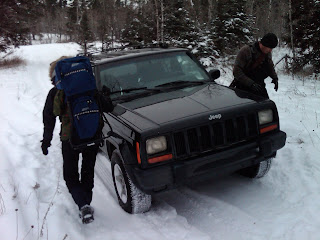
... strapped it on the Jeep...
... set it up at home...
... and then, yesterday, we decorated it.

It was a great day to spend in God's amazing creation with good friends and family!

And yes, this is a picture of a Jeep pulling a Ford up a hill! ;)

Tuesday, December 14, 2010

Wednesday, December 8, 2010

I found a Unicorn!

Yup, I found a unicorn... in the BIBLE!

Well, sort of.

I've been reading through the Psalms for my regular devotions, and to mix it up I've been reading them in the Septuagint (LXX); yes, I'm on a bit of a LXX kick.

Anyway, just yesterday I was reading through the famous Ps 22 when I bumped right into a unicorn. Needless to say, neither of us were expecting it, but neither me nor the unicorn were hurt in any way, so I think we're all good.

Any normal translation will read something along the lines of this:
Psalms 22:21 (ESV) "Save me from the mouth of the lion! You have rescued me from the horns of the wild oxen!" [ESV, NASB, NIV, NRSV, NLT, NKJV all say "wild oxen"]

What I read in the LXX was:
Psalm 21:22 [22:21] (SAAS) "Save me from the lion's mouth, My humiliation from the horns of the unicorns."

That I know of, there are only 3 published English translations of the LXX (Sir Lancelot Brenton's, the St. Athanasius Academy Septuagint [SAAS], and the New English Translation of the Septuagint [NETS]) and they all have "unicorn" in this verse!

The word here is "monovkerwV" (monokeros) meaning simply, "one-horn" (mono = one; keras = "horn"). So, with the help of my old Greek prof, we put together the following:

- The LXX is a Greek translation of the Hebrew scriptures (i.e. the Old Testament).
- This translation was done by Jews in Alexandria, Egypt
- The term "wild oxen" has been taken to be referring to an antelope type animal known as an "oryx"
- In Egypt, the hieroglyph for oryx is something that looks a lot like: ó
- Based on the hieroglyph one can easily see how people would then call the oryx a "one-horn"

But, why then would it not just be translated as a "one-horn" or oryx?

Well, the fact is that this word, monokeros/one-horn, was also used in ancient Greek literature to describe what is thought to be the origin of the "myth" of the unicorn.

Ctesias, a Greek physician from the 5th century BC, writes about an unusual creature they (supposedly) found in India:

"[§45] In India there are wild asses as large as horses, or even larger. Their body is white, their head dark red, their eyes bluish, and they have a horn in their forehead about a cubit in length. The lower part of the horn, for
about two palms distance from the forehead, is quite white, the middle is black, the upper part, which terminates in a point, is a very flaming red. Those who drink out of cups made from it are proof against convulsions, epilepsy, and even poison, provided that before or after having taken it they drink some wine or water or other liquid out of these cups. The domestic and wild asses of other countries and all other solid-hoofed animals have neither huckle-bones nor gall-bladder, whereas the Indian asses have both. Their huckle-bone is the most beautiful that I have seen, like that of the ox in size and appearance; it is as heavy as lead and of the color of cinnabar all through. These animals are very strong and swift; neither the horse nor any other animal can overtake them. At first they run slowly, but the longer they run their pace increases wonderfully, and becomes faster and faster. There is only one way of catching them. When they take their young to feed, if they are surrounded by a large number of horsemen, being unwilling to abandon their foals, they show fight, butt with their horns, kick, bite, and kill many men and horses. They are at last taken, after they have been pierced with arrows and spears; for it is impossible to capture them alive. Their flesh is too bitter to eat, and they are only hunted for the sake of the horns and huckle-bones."

The people of the day thought of the monokeros/unicorn (latin: uni = one; cornu = horn) as an actual, true to life animal and not as a mythological creature (as opposed to, say, sirens). The best I can understand, it was only in the middle ages when the unicorn began to take on more mysterious, magical, and mythological traits... although based on what Ctesius says, it's easy to see why.

On the other hand, some people think that the monokeros is really just talking about a rhinoceros.

Incidentally, the King James also says "unicorn" in this verse as it follows the latin Vulgate for this verse (Jerome used the LXX to translate the Psalms).

So, I guess that's that.
Uh, I guess, feel free to comment (or not) as you feel fit?

Tuesday, December 7, 2010

Jesus, History, and the Greek NT

Here's a great little clip (OK, it's about 10 min.) of BW3:

Friday, December 3, 2010

Yes, this is funny

Michael F. Bird strikes again!

Here he's doing a silly little promo for the SBL's (Society of Biblical Literature's) new critical Greek Text of the New Testament. They are doing their best to give the NA27/UBS4 a run for their money! And yes, in case you weren't sure, this is funny.

And while we're at it, I want to share a link with you that may prove to be extremely valuable for those who care. Here (yes, click here) is a website that someone has put up listing EVERY SINGLE CHANGE in the various forms of the NIV (NIV'84 - TNIV - NIV'11). This is an insane amount of information! So, if you want to know how these various updates differ, this is the place to go.

Ah, good ol' Joshua:
Yesterday Ben Witherington posted an interesting discussion between himself and colleague Lawson Stone. Drs Witherington and Stone are both Profs at Asbury Theological Seminary. Witherington is Professor of New Testament Studies and Stone is Professor of Old Testament Studies. Here they get into a gracious debate about the nature of violence in the Bible and the idea of God as a Warrior. If you've ever struggled with the violence in the Bible or the whole issue of war, non-violence, and pacifism you should check this out. Very interesting.

They both posted the discussion:
Witherington's Page (here)
Stone's Page (here)

Wednesday, December 1, 2010

All is Calm?

"Silent night, holy night, all is calm..." Really? Calm? Have you ever seen a woman in labour? And I can't help but think that adding a bunch of stinky shepherds to the mix is going to help anything. "How silently, how silently the wondrous gift is giv'n..." Wondrous, yes. Silent, not likely!

"It came upon the midnight clear..." Well, I suppose it could have; it just doesn't say. All Matthew has to say is "Now after Jesus was born in Bethlehem..." (Mt. 2:1) and Luke simply states that "while they were there, the time came for her to give birth" (Lk. 2:6). Yes, the angels appeared to the shepherds at night (Lk. 2:8) but that's the closest time-frame we've got... I guess, in all fairness, the song is talking mostly about the shepherds and the angels... but then what's the point of the song? If it's not about Jesus, why bother singing it?

It doesn't take much to find some Carols that have inaccuracies, poor theology, or just silly statements. So should we scrap them?

Just this morning I ran across this quote which attempts to answer that question:

Should we get rid of Christmas Carols?
Only with great care. For thousands, carols will be their only link with a church. At the same time, sentimentality is perhaps the single most dangerous feature of our Church and culture—and the sentimental air is never thicker than at Christmas. The Incarnation is messy, dirty, and resonates with the crucifixion. We need a new wave of carol writing that can gradually swill out the nonsense and catch the piercing, joy-through-pain refrains of the New Testament.” - Jeremy Begbie, professor of theology, Duke Divinity School

What do you make of that?
What carols are worth keeping?
Which carols are worth ditching?
Do you know of any new Christmas/Advent songs that are worth singing?

Wednesday, November 24, 2010

Word Designs

A while ago I discovered a website by a guy named Jim LePage. Jim is a graphic designer and has been doing a project simply called "Word." Basically, he's been doing "book covers" for each book of the Bible. He's come up with some pretty interesting stuff. Check it out: here. Click on the picture to see a larger view and a write-up/reflection on his thoughts as to why he did what he did for that particular book.

Here are a few samples.

Some of them are pretty straightforward, like this one from Nehemiah:


Some of them are mildly ironic, like Job:
You get the idea.


Ecclesiastes:

1 Samuel:

Judges

All of the ones I posted here are pretty tame. Others of his are a little more provocative. There are some of these that, in his own words, "will probably not be hanging in the youth room of your church."

Anyway, check out his pictures and his little write-ups.
Which ones stand out to you?
Why?

Saturday, November 20, 2010

Hearing Music Everywhere!

I ran across Charles Spearin's "The Happiness Project" a while ago (I think it was on CBC Radio 2's "the Signal"). The idea totally intrigued me: He had interviewed a whole bunch of his neighbours about what they thought it meant to be happy in life. Then he listened to the natural tonality in their conversations and turned it into music.

I know it's totally outside of most of our musical boxes, but you gotta check this out:


So?